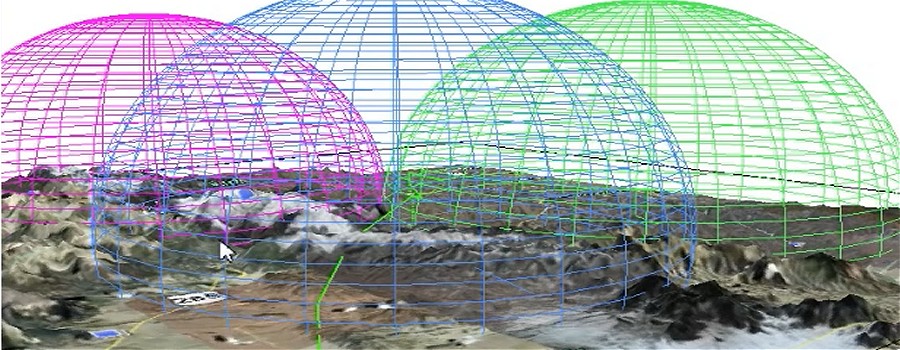
Optimal Radar positioning for Missile Detection
Optimal radar positioning for missile detection maximizes line-of-sight and minimizes blind spots caused by the Earth's curvature and terrain masking. In complex environments, software like vsTASKER by VirtualSim is used to automate radar placement, evaluate coverage, and optimize defense configurations through batch simulations.vsTASKER Simulation WorkflowvsTASKER acts as a powerful tool for analyzing radar placement and missile trajectory optimization. It evaluates detection performance by running thousands of iterations against threat scenarios.Terrain Modeling: vsTASKER utilizes 3D terrain and Digital Elevation Models (DEMs) to calculate radar shadow zones and depression angles.Automated Placement: The software places radars on the terrain based on exclusion rules (e.g., avoiding low valleys, areas too close to the target, or blind spots).Monte Carlo Optimization: vsTASKER runs batch simulations using stochastic or heuristic methods. It randomly varies radar positions, missile speeds, and "nap-of-the-earth" (NOE) flight paths to minimize detection probability.Evaluation: After multiple runs, vsTASKER stores configuration data in databases and identifies the optimal setups for simultaneous and continuous detection.Principles of Optimal Radar PlacementFor effective missile defense, placement strategies must account for both physical geography and sensor capabilities.High Ground/Elevated Sites: Radars placed on hilltops or mountains extend the horizon line and "see" further over terrain clutter.Over-The-Horizon (OTH) or Space-Based Assets: Because ground radars are limited by the Earth's curvature, early-warning satellites (modeled via TLE orbital data in vsTASKER) are crucial for detecting long-range ballistic missiles.Networked Sensors: Placing multiple radars in overlapping configurations prevents single-point failures and reduces gaps left by terrain shadowing.Airborne Early Warning & Control (AEW&C): Air-based radars can detect low-flying cruise missiles that would otherwise be hidden by the curvature of the Earth.Ballistic vs. Cruise Missile DetectionDifferent missile threats require different radar positioning strategies.Ballistic Missiles: These fly very high and fast. They are often detected by long-range early-warning radars stationed at high latitudes or via space-based sensors.Cruise Missiles: These fly at very low altitudes to evade detection (Nap-of-the-earth). To counter them, radars must be placed on high elevation vantage points or integrated on airborne platforms to eliminate blind spots caused by hills and valleys.
Eliminates low-altitude placements where terrain mask limits the radar's early warning horizon.Proximity Buffers: Forces a minimum distance between nodes to prevent overlapping redundancy and maximize overall coverage.Range Thresholds: Eliminates extreme out-of-bounds positioning too far away from the protected fixed target or the missile launch origin.3. Scoring & Batch SimulationMonte-Carlo Iterations: The engine runs thousands of high-frequency parallel simulations.Key Metrics Monitored: Total cumulative detection duration, simultaneous multi-radar tracking, and the delay between missile launch and initial detection.Final Export: The engine scores every batch cycle, systematically outputting the top ten optimal configurations to disk for defense planning.I can provide the specific step-by-step setup for batch modes or sensor component modeling in vsTASKER. Let me know if you would like to explore:Configuring Probability of Detection curves vs. Missile RCSHooking up stochastic optimization algorithms in the runtime engineIncorporating space-based or TLE orbit trackers alongside your ground-based radars
Reference image showing features of vsTASKER
Reference video showing features of vsTASKER
How vsTASKER Solves ThisvsTASKER is a sophisticated simulation software used by military planners to optimize radar and missile engagement configurations. It automates the positioning and testing process using several advanced strategies:Automated Terrain Rules: vsTASKER features built-in rule engines. You can define parameters (e.g., "exclude valleys," "keep 50km apart from other units") and the software will filter out poor positions.Dynamic Threat Modeling: The software allows users to launch a threat missile that flies specific profiles—such as a Nap-of-the-Earth (NOE) maneuver. The missile attempts to dodge radar detection using terrain masking.Monte Carlo / Stochastic Optimization: vsTASKER can run thousands of scenario iterations, randomizing radar positions and missile flight paths.Continuous Evaluation: After running thousands of batch cycles, the software monitors detection time, which radars saw the threat first, and which radar configurations yielded the highest success rates.Result Storage: The software saves the top configurations in a database, allowing operators to analyze and deploy the most statistically successful radar networks.If you want to optimize your simulation, let me know:What type of missile are you simulating (ballistic, cruise, hypersonic)?Are you using ground-based, airborne, or naval radars?What specific terrain database (e.g., flat desert, mountainous) are you running the scenario on?
Downlaod - Optimal Radar positioning for Missile Detection
Request for Trial licence
Download User Guide & reference manual
Key Positioning PrinciplesWhen setting up a radar network for early missile detection, the primary goal is to spot the threat as early as possible without compromising the radar itself.Line of Sight (LOS): Radars must be positioned at high elevations to maximize the radar horizon and spot low-flying or incoming threats as early as possible.Terrain Masking: Place radars behind natural terrain features (like ridges) to protect against enemy jamming and direct-fire attacks, while allowing the radar beam to scan over the top.Overlapping Coverage: Ensure that multiple radars cover the same airspace to prevent blind spots and increase tracking accuracy.Avoid Flat Terrains: Eliminate valley and open-field positions where the radar is highly visible and vulnerable.