Proximity Mesh and Combinatorial Explosion
vsTASKER utilizes proximity meshes as a spatial analysis tool to manage and simulate the "combinatorial explosion" that occurs when thousands of moving entities interact. It is a C++ based visual modeling SDK designed by VirtualSim for real-time scenario generation, military war gaming, and physical particle tracking.Understanding how vsTASKER tackles complex entity behaviors involves looking at a few core mechanics: Combinatorial Explosion: When thousands of independent entities (like swarms of drones, particles, or infantry) share a space, the number of potential interactions multiplies exponentially. This mathematical overload can quickly crash traditional simulation logic.Proximity Mesh Application: To prevent this, vsTASKER lays a spatial grid over the simulation environment to cluster entities logically. The engine calculates collisions and interactions only between entities in the same or adjacent mesh zones, rather than checking every entity against every other entity.Performance Maintenance: By localizing proximity checks, vsTASKER avoids mathematical bottlenecks and maintains a steady frame rate (typically at 30Hz) while tracking 20,000+ entities simultaneously.

Batch Processing: To solve optimal pathways or best-case scenarios among billions of potential moves, the software runs millions of rapid background simulations, skipping the visual rendering to isolate the most effective outcomes.
In the context of vsTASKER, "Proximity Mesh and Combinatorial Explosion" refers to a specific real-time simulation use case designed to showcase how the software handles thousands of interacting entities efficiently without crashing system performance.

The Problem: Combinatorial ExplosionIn standard simulation engines, calculating interactions (like collisions, detections, or clumping behaviors) for N entities typically requires an All-Pairs approach. This means every entity checks its distance against every other entity, resulting in an O(N²) computational complexity. For 1,000 entities, the engine must compute 1,000,000 checks per frame.For 10,000 entities, this skyrockets to 100,000,000 checks per frame.This exponential surge in processing requirements is known as a combinatorial explosion, which quickly bottlenecks CPU performance and drops the simulation frame rate.The Solution: The Proximity MeshTo bypass this limitation, vsTASKER implements a specialized Mesh feature (similar to a spatial partitioning grid or cellular automaton setup). Instead of checking every entity against all others, the simulation space is mapped onto a local proximity grid:

Spatial Binning: Entities register their coordinates into specific "cells" or local sectors within the mesh.

Localized Lookups: When an entity calculates its behaviors (such as clumping, flanking, or avoidance), it only checks for neighbors within its immediate or adjacent mesh cells.

Linear Complexity: This reduces the computational overhead from an unmanageable quadratic scale (O(N²)) down toward a sustainable, near-linear scale (O(N)).

The vsTASKER Benchmark DemonstrationVirtualSim uses this specific scenario as a technical showcase for vsTASKER's high-performance runtime engine:

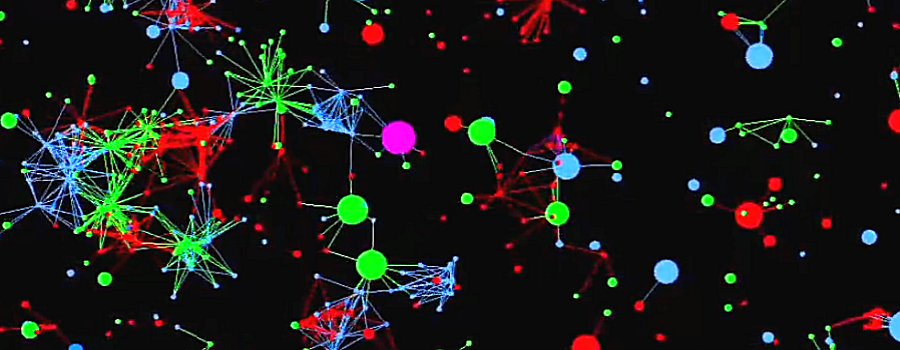
Objective: Simulating the real-time clumping and organizational behavior of thousands of active particles/entities.

Performance: Achieving a stable, real-time 30Hz refresh rate while handling large-scale crowding dynamics.

Related Applications: This identical proximity mesh logic underpins other vsTASKER benchmarks, such as stress-testing 20,000 autonomous entities with simultaneous sensor detections, managing massive drone swarm shields, and rendering complex cellular behaviors like Conway's Game of Life.
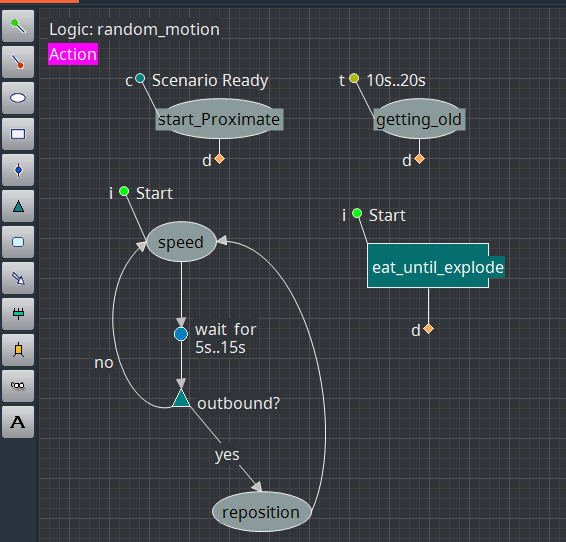
Reference image showing features of vsTASKER
Reference video showing features of vsTASKER
How vsTASKER Solves the Problem Instead of letting every entity check its distance against every other entity (which scales exponentially), vsTASKER handles the computational load by:Spatial Grids: Dividing the simulation space into computational nodes or hexahedrons (a proximity mesh) to create a porous space for fluid or particle dynamics.Proximity Tracking: Constraining entities to query only their immediate local mesh cells for potential collisions, rather than checking the entire map.C/C++ Logic Injection: Allowing developers to inject custom C/C++ code, keeping the physics and movement vectors optimized for real-time performance.
Downlaod - Proximity Mesh and Combinatorial Explosion
Request for Trial licence
Download User Guide & reference manual
Practical Application While the baseline demo uses "particles," in defense and aerospace simulation (the primary markets for vsTASKER), this mechanism is used to cleanly execute:Drone Swarms: Simulating thousands of micro-UAVs coordinating or colliding without crashing the host CPU.Air Traffic Control (ATC): Handling high-density flight tracking and proximity alerts across dense regional airline sectors.Electronic Warfare: Managing thousands of signal paths, jamming envelopes, and sensor sweeps tracking multiple targets across a massive battle space