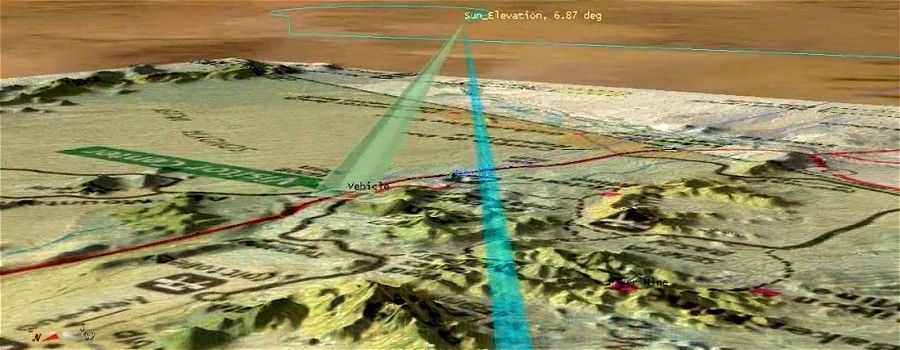
Satellite Toolkit (STK) Integration
Systems Tool Kit (STK) and vsTASKER serve different primary purposes in the simulation world, but they are often integrated to merge deep aerospace/orbital analysis with high-level tactical logic.The core difference is that STK is an advanced analytical software specialized in orbit modeling, aerospace, and line-of-sight communications. vsTASKER is a real-time logical simulation engine used to build complex military tactics, AI behaviors, and gaming environments.Here is how they stack up and work together:Ansys STK (Satellite Tool Kit)What it does: Calculates exact orbital mechanics, satellite coverage, sensor payload, and RF/laser communications.Strengths: High-fidelity space environment, 3D visualization, and precise physical tracking.Best for: Aerospace engineers, mission analysts, and satellite constellation design.vsTASKERWhat it does: Allows users to design logic networks, military tactics, and artificial intelligence for entities (troops, vehicles, drones, and command centers).Strengths: Real-time execution, flexible event-driven logic, and easy integration with game engines (like VBS).Best for: Military wargaming, doctrine testing, and C4ISR (Command, Control, Communications, Computers, Intelligence, Surveillance, and Reconnaissance) analysis.How the Integration WorksIntegrating STK with vsTASKER allows users to combine the strengths of both tools.Command & Control (C2) Testing: vsTASKER simulates the tactical decisions of troops or commanders. When they request satellite support, vsTASKER sends requests to STK.Orbit Analysis: STK calculates if a satellite is in position to provide the requested data or communication link and passes the access time and data back to vsTASKER.Visualization: The two systems synchronize their timelines. vsTASKER feeds its tactical actions into STK, or STK passes its orbital parameters to vsTASKER's connected 3D rendering engines.To learn more about their respective toolsets, visit the official Ansys STK and Virtual Simulation vsTASKER pages.If you're evaluating these for a specific project, let me know:Is your focus more on space mission design or tactical wargaming?Are you looking to build custom C++ code or use pre-built graphical interfaces?
When integrating Ansys Systems Tool Kit (STK) with vsTASKER, you bridge high-fidelity astrodynamics and physical environment analysis with a real-time tactical simulation engine.While STK excels at calculating complex geometric inter-visibility, orbital physics, and sensor coverages, it lacks the flexibility to handle real-time branching logic, tactical synthetic forces, and complex, dynamic decision-making. vsTASKER solves this by managing the simulation logic and using STK as an external computation engine.Key Capabilities of the IntegrationCombining these two platforms allows you to create high-fidelity aerospace and defense scenarios, enabling logic-driven events like:Dynamic Intercepts: Instructing a missile or aircraft to change its trajectory dynamically inside vsTASKER based on an STK-computed sensor detection.Constellation Cross-linking: Activating cross-link communication pathways or routing dynamic data payloads between satellites only when they achieve an STK-calculated Line of Sight (LOS).Responsive Ground Stations: Automating ground station dishes to track, beam, or intercept telemetry signals the exact second an orbiting asset enters their field of view.Technical Integration ArchitectureThe integration between the two software platforms relies on native connection pipelines provided by VirtualSim's STK integration module:Integration MethodHow It WorksBest Used ForLAN / ConnectvsTASKER sends asynchronous string commands and receives data packets over a standard TCP/IP network socket connection.Distributed simulations across multiple machines.COM / ActiveXvsTASKER directly drives the STK desktop application or STK Engine instance locally using object component APIs.Real-time desktop automation and scenario synchronization.Static / Exported LibrariesvsTASKER compiles and combines its generated C++ code directly with STK libraries.High-performance standalone execution requiring ultra-low latency.Structural Comparison: When to Use WhatIf you are evaluating whether to use STK natively or route your simulation logic through vsTASKER, look at how their responsibilities split:┌─────────────────────────────────┐       ┌─────────────────────────────────┐
│           vsTASKER              │       │          Ansys STK              │
│  (The "Brain" / Logic Engine)   │──────>│  (The "Physics" / Geospatial)   │
├─────────────────────────────────┤       ├─────────────────────────────────┤
│ • Human-In-The-Loop inputs      │       │ • Orbital Mechanics / TLEs      │
│ • State machines & logic forks  │       │ • Antenna & RF link budget      │
│ • C++ automated code generation │       │ • High-res 3D terrain masking   │
└─────────────────────────────────┘       └─────────────────────────────────┘
Use STK natively if your goal is strict mission planning, trajectory design via Astrogator, calculating accurate solar radiation pressure, or running pre-determined constellation coverage reports.Use the vsTASKER + STK Integration if your simulation demands unexpected, real-time responses to unpredictable tactical events (e.g., electronic warfare jamming turning on/off based on pilot behavior, or dynamic counter-measure deployment).Would you like to explore a specific example of how vsTASKER handles the API hooks for STK, or are you looking to design a specific mission profile using this architecture?
Reference image showing features of vsTASKER
Reference video showing features of vsTASKER
How the Integration WorksCommunication Schemes: vsTASKER connects to STK via native APIs such as COM, ActiveX, or LAN (TCP/IP).Command & Control: vsTASKER generates time-step commands to send to STK (e.g., changing the trajectory of an aircraft or activating a specific sensor) and receives asynchronous results back for in-scenario decision-making.Data Logging: Results computed by STK can be passed back to vsTASKER for further processing, or stored in a SQL database for offline statistical analysis.
Downlaod - Satellite Toolkit (STK) Integration
Request for Trial licence
Download User Guide & reference manual
Common Use CasesSpace-Ground Communication: vsTASKER controls ground networks and mobile stations (e.g., ships, trucks) while STK provides precise, time-dynamic orbital mechanics (like satellite passes and link budgets) to dictate exactly when communication is possible.Sensor and Detection Filtering: vsTASKER simulates broad background forces and high-level platform movements. Once a potential target is within range, it delegates the fine-tuned, high-fidelity sensor and terrain masking calculations to STK.Missile Defense & Interception: vsTASKER models the logic of the defense strategy, launch conditions, and unit decisions. STK provides the exact kinematics, radar cross-sections, and line-of-sight tracking to validate if a satellite, missile, or aircraft can successfully intercept or observe a target.C4ISR & Space Weather Impacts: vsTASKER handles the flow of command signals and operational decisions. STK informs this network by simulating space weather, atmospheric effects, and satellite coverage shadows that could disrupt or enable battlefield communications.