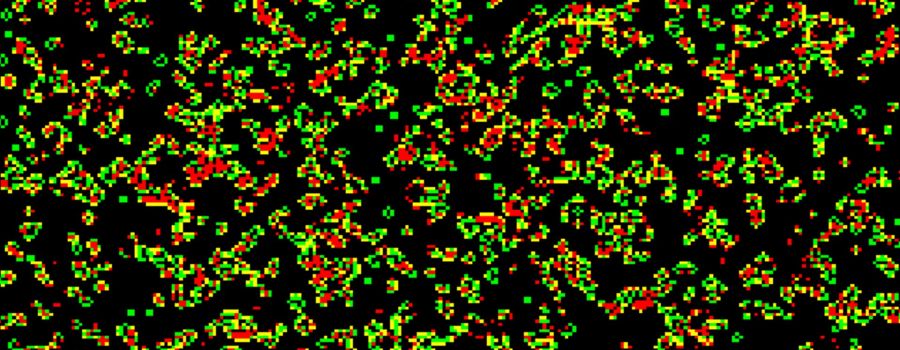
The Game of Life Algorithm
Conway's Game of Life is a famous mathematical simulation created by mathematician John Horton Conway. The vsTASKER simulation software implements this algorithm to showcase its real-time event-driven processing, cellular automaton capabilities, and stress-testing functionalities.The Game of Life is a "zero-player game," meaning its evolution is determined by its initial state and requires no further input The Algorithm in vsTASKERIn vsTASKER, this algorithm is used to demonstrate how the software's engine handles spatial conditions, proximity checks, and state changes across thousands of grid-based entities per second.Cellular Representation: The grid is often mapped using a 2D array or proximity mesh.State Management: vsTASKER evaluates cells in two steps—counting neighbors for the whole grid, then applying the rule-based state changes—to ensure all updates happen at the same time.Performance: The platform uses this simulation to stress test its engine, proving it can process tens of thousands of dynamic "entities" (like cells or agents) while maintaining smooth performance.You can read more about how this cellular automaton fits into the software's capabilities on the official vsTASKER Portfolio page.Would you like to know more about how vsTASKER implements the simulation's code, or are you interested in other algorithms featured in their software, such as the Boids Flocking Algorithm?
Key vsTASKER Technical Features UsedThe primary purpose of this demo within the VirtualSim Portfolio is to highlight how vsTASKER handles intensive spatial processing:Proximity Mesh Mechanism: In standard software, mapping thousands of cells and calculating their intersecting neighbors creates a combinatorial explosion. vsTASKER uses its high-performance Mesh feature to group spatial areas, ensuring the simulation runs at real-time speeds (typically 30Hz or higher).Interactive Control (HMI Builder): The simulation is map-driven and user-interactive. Operators can use keyboard hotkeys dynamically while the execution engine runs to:Drop random clusters of alive cells.Inject predefined structures (like spaceships or oscillators).Change the operational rules on the fly to mutate the grid's visual growth.Simultaneous Evaluation: vsTASKER's engine evaluates all state modifications synchronously via a double-buffering logic, preventing premature cell updates from altering the calculation of neighboring states within the same cycle.If you are trying to reproduce this behavior inside your own environment, would you like me to provide a C++ structural logic framework or look into how vsTASKER sets up its Proximity Mesh for entity detection?
Reference image showing features of vsTASKER
Reference video showing features of vsTASKER
The vsTASKER use case for Conway’s Game of Life algorithm is a practical demonstration of cellular automata and grid-based entity tracking within a visual simulation engine. It serves as a testing ground for mass-scale proximity logic and swarm behaviors, handling thousands of dynamic states seamlessly.Core ImplementationGrid Mechanics: vsTASKER maps the algorithm across a 2D grid utilizing its built-in Mesh feature.Scalability: It runs performance benchmarks across different mesh dimensions, from a small array of 6,000 cells up to 60,000 cells.Entity States: Every execution cycle applies mathematical rules based on neighbor proximity to change entities from dead to alive, or alive to dead.Interaction: The simulation includes keyboard shortcuts that allow users to activate the algorithm, drop random cells, alter the ruling logic, and inject predefined structural patterns.
Downlaod - The Game of Life Algorithm
Request for Trial licence
Download User Guide & reference manual
Simulation RationaleStress Testing: vsTASKER uses the Game of Life to stress test the software's engine, ensuring it can handle computational loads representing thousands of entities without lagging.Swarm Logic: The proximity principles learned from the Game of Life are applied to real-world defensive behaviors, such as clumping algorithms for particle simulations or managing drone swarms.